Web development for law firms that actually performs.
Custom-engineered websites with real CRM integrations, sub-second load times, and WCAG 2.1 AA accessibility. Three- to six-week builds, fixed-price, source-code handoff. Next.js by default, WordPress on request.
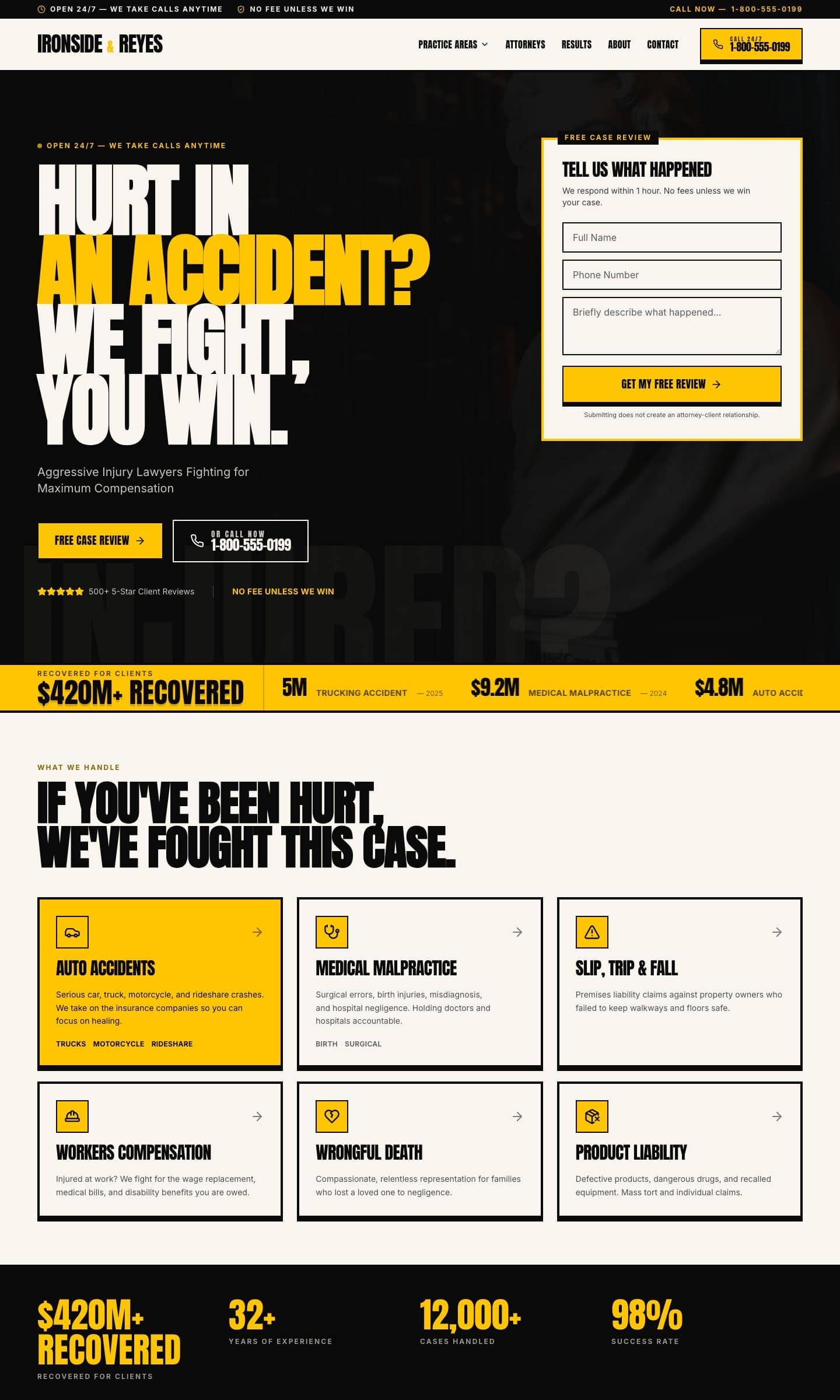
Ironside & Reyes
Personal injury · Next.js 15 + Sanity · 26 routes
- Lighthouse Perf
- 98/100 mobile
- Accessibility
- 100/100
- LCP (mobile 4G)
- 2.2s
- CLS
- 0.00
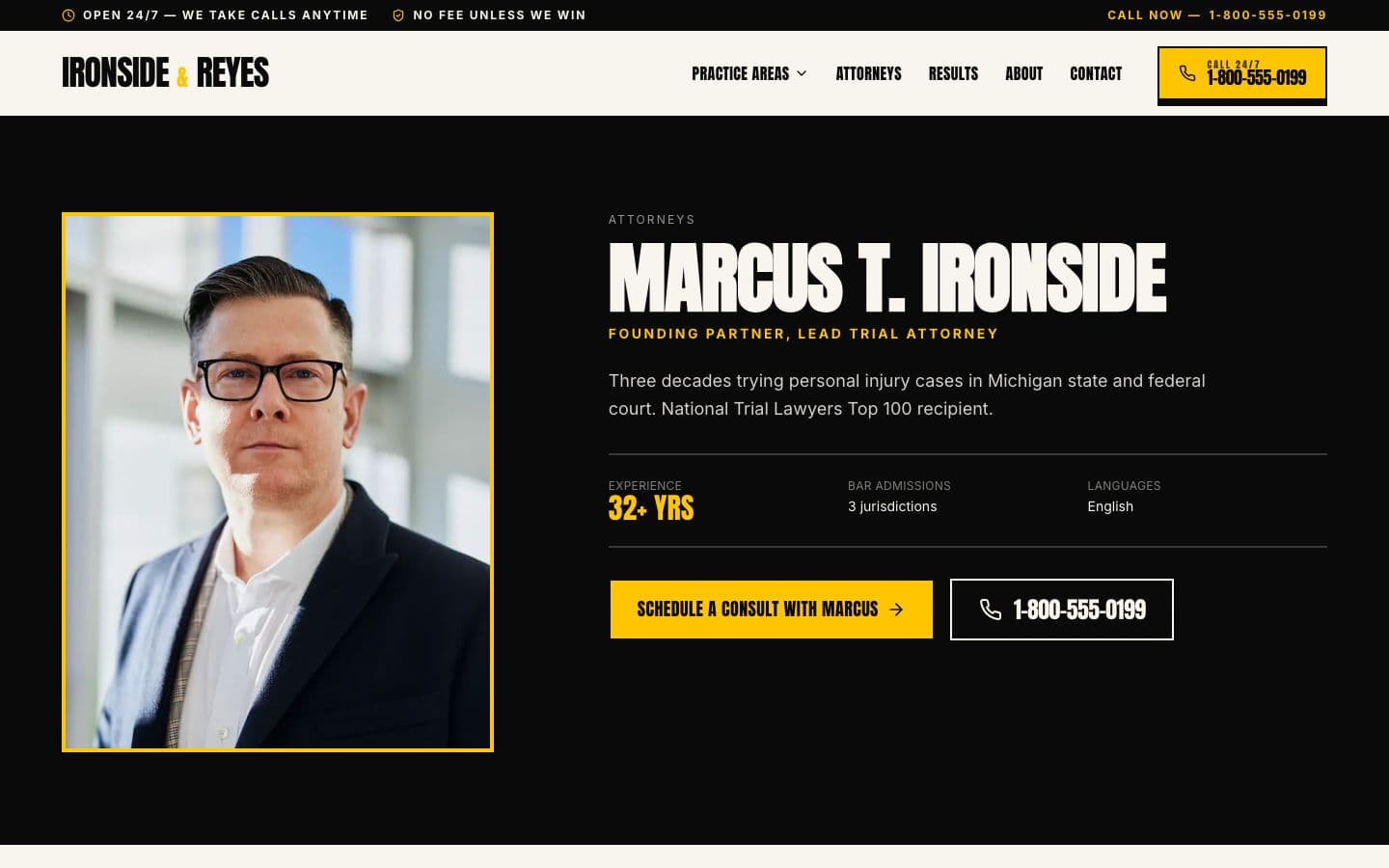
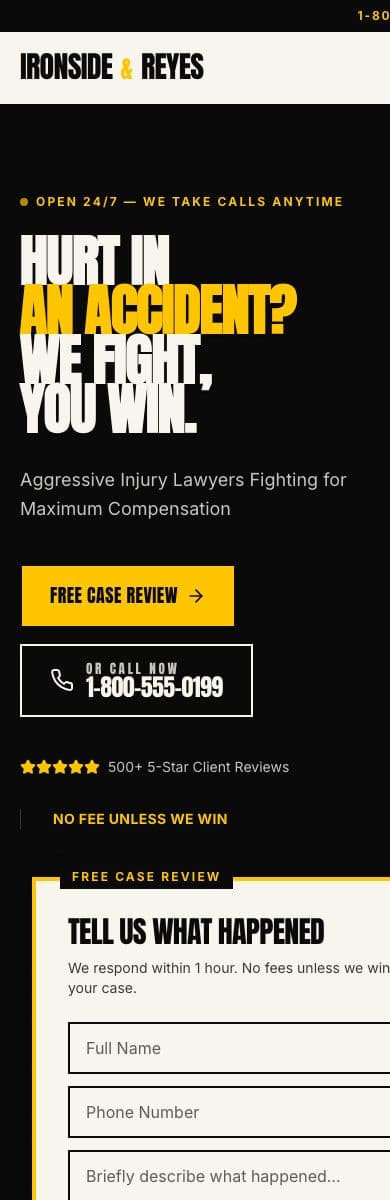
Statically-rendered Next.js 15 with React 19, Sanity v3 for content authoring, Tailwind for the design system. WCAG 2.1 AA conformant. 26 pre-generated routes including practice-area sub-slugs and individual attorney bios. Schema markup on every entity page.
Four engineering failures we see on every audit.
Page-builder bloat kills rankings
Elementor, Divi, WPBakery — they all stack 600+ KB of JavaScript before your homepage even paints. Google measures Core Web Vitals as a ranking signal. A slow site is a buried site.
Broken or non-existent CRM integrations
Your intake forms should write directly into Clio, MyCase, or Filevine — not into the WordPress admin where they get forgotten. Most legal-vertical builds skip this entirely.
Accessibility gets ignored until a demand letter arrives
Law firms are a prime ADA litigation target. We build to WCAG 2.1 AA from day one — keyboard navigation, screen-reader labels, color contrast, focus states — not bolted on after a complaint.
Security holes built into the theme
Most legal sites run unpatched plugins on shared hosting. We build on Vercel's static-rendering model (zero server attack surface) or, for WordPress, on managed hosts with automated security and patch monitoring.
Five phases. Three to six weeks. Performance budgets enforced in code review.
We work in concrete artifacts at each milestone — architecture diagram, performance budget, integration test results, accessibility report. Partners review what they can actually evaluate.
Book a strategy call- 01
Architecture and tech audit
We map your existing stack, intake flow, and CMS. Output: a technical scope with explicit integration list, performance budget, and accessibility checklist.
- 02
Component-first build
We compose your site as reusable components in code. Each component is type-checked, accessibility-tested, and storyboard-reviewed before it composes a page.
- 03
Integration wiring
Intake form to Clio/MyCase/Filevine. GA4 + Search Console. GTM events. Email forwarding rules. Each integration tested with real submissions before launch.
- 04
Performance and a11y QA
Lighthouse on every key route, axe-core scan, manual keyboard test, screen-reader sweep. We fix what we find before the partner review, not after.
- 05
Launch + source-code handoff
DNS cutover with monitored 301s, GA4 verification, Sanity (or WordPress) admin access, full Git repo handed to your account. 30-day post-launch support included.
Every engineering deliverable, named.
Fixed scope. If something is in this list, it is shipping with your launch.
Headless Next.js + Sanity architecture
Statically-rendered pages served from Vercel's global edge network. Content edits in Sanity Studio go live without a redeploy. Same stack we built the demo on.
Sub-1-second LCP target
We set a hard performance budget at the architecture stage. Every page ships with a Lighthouse mobile score of 90+. We monitor with Vercel Speed Insights post-launch.
WCAG 2.1 AA conformance, validated
Skip links, proper semantic structure, keyboard-navigable everything, reduced-motion support, color-contrast verified, automated axe-core checks in CI. Real conformance, not a badge.
CRM and intake integrations
Direct API integration into your case management system — Clio, MyCase, Filevine, Lawmatics, or your own. Lead form submissions become matter records, not orphaned emails.
Structured data + JSON-LD schema
Attorney pages with Person + lawyerOf schema, firm-level LegalService, FAQ schema on relevant pages, BreadcrumbList everywhere. Google understands what your site is. So does ChatGPT.
Source code + version control handoff
Code lives in a Git repo we transfer to your account. You can fire us tomorrow and keep building. No proprietary page-builder lock-in, no "who owns the website" surprises.
Three engineering tiers. Fixed scope. No hourly billing.
Final number comes out of the free strategy call. These are honest ranges, not ceiling-of-the-rainbow quotes.
Solo practice
$3,250–4,750
Single attorney, 1–3 practice areas, one CRM integration.
- Custom Next.js + Sanity build
- 3 practice-area pages
- Attorney bio with schema
- Lead form → CRM integration
- GA4 + Search Console setup
Mid-size firm
$5,000–8,000
2–5 attorneys, 4–8 practice areas, content migration of up to 100 posts.
- Everything in Solo, plus
- 4–8 practice-area pages
- Up to 5 attorney bios
- Case-results section + schema
- Custom search + filtering
Multi-partner firm
$9,000–12,000
6+ attorneys, 9+ practice areas, multi-office, custom integrations.
- Everything in Mid-size, plus
- Up to 12 practice-area pages
- Up to 15 attorney bios
- Multi-office location schema
- Custom intake + matter routing
- Spanish-language pages (optional)
Ongoing care plans start at $150/month and cover hosting, monthly content updates, blog publishing, GA4 reporting, and CMS admin support.
Looking at this more broadly?
If you're shopping for a website rather than the engineering behind it, the design-focused breakdown is here:
Technical answers to the questions IT and ops actually ask.
Stop renting a website. Own the code.
Free 30-minute strategy call. You leave with a written technical scope, a target launch date, and a fixed price — whether you hire us or not.