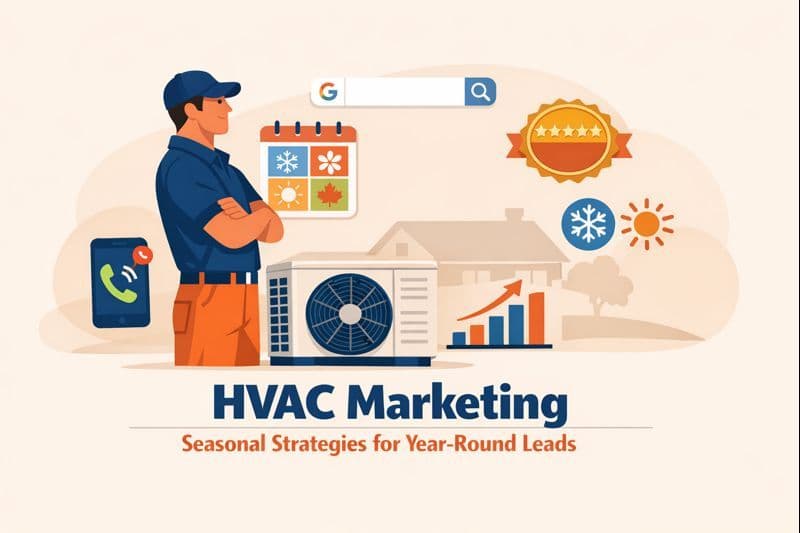
The HVAC Marketing Reality: Why Traditional Approaches Fall Short
Your technical expertise can fix any heating or cooling problem, but expertise alone doesn't fill your schedule.
Most HVAC contractors still rely on word-of-mouth referrals and the occasional Yellow Pages listing. But here is the reality: 89% of homeowners now search online for local HVAC services, and your competitors who embrace digital marketing are capturing those leads while you wait for the phone to ring.
The HVAC services market is projected to reach $367.5 billion by 2030, growing at 6.1% annually. This growth creates massive opportunity, but also intensifies competition. Your seasonal demand fluctuations make marketing ROI particularly challenging: you need strategies that work during both emergency spikes and maintenance lulls.
Digital transformation isn't optional anymore. Homeowners expect immediate responses, transparent pricing, and proof of your expertise before they call. They research your online reputation, compare your Google reviews, and evaluate your website professionalism within seconds of finding you.
The HVAC companies thriving in 2026 understand that marketing isn't an expense: it's revenue infrastructure. They implement comprehensive HVAC marketing strategies that turn seasonal challenges into competitive advantages and transform one-time emergency calls into lifetime customer relationships.
Seasonal Marketing Calendar: Maximizing Year-Round Lead Generation
Your marketing calendar should mirror your customers' comfort needs, not your convenience.
Peak season emergency marketing requires 24/7 readiness. When temperatures hit extremes, mobile searches for HVAC services increase by 140%. Your Google Ads campaigns need weather-triggered activation, your website must load instantly on mobile devices, and your phone system requires after-hours coverage.
During summer heat waves and winter freezes, position your emergency services with premium messaging. Homeowners experiencing system failures will pay higher rates for immediate relief. Your marketing should emphasize rapid response times, diagnostic expertise, and same-day availability.
Off-season maintenance contract promotion becomes your revenue stabilizer. Spring and fall represent optimal timing for annual agreement sales. Homeowners aren't in crisis mode, making them more receptive to preventive care messaging. Your campaigns should focus on system longevity, energy savings, and priority scheduling benefits.
Weather-triggered campaign automation ensures you never miss opportunity windows. Set up Google Ads to increase bids when local temperatures exceed seasonal norms. Configure Facebook campaigns to activate during weather advisories. Schedule email sequences to deploy when your service area experiences equipment-stressing conditions.
This systematic approach transforms seasonal volatility into predictable lead flow. Instead of feast-or-famine cycles, you maintain consistent customer acquisition while maximizing revenue during peak demand periods.
Local SEO Dominance: Capturing the 15-Mile Radius
Your service area determines your revenue potential, and local search dominance determines who finds you first.
Google My Business optimization forms your local marketing foundation. Your profile needs complete information: accurate address, phone number, service area boundaries, business hours, and comprehensive service descriptions. Upload high-quality photos of your team, vehicles, and completed installations. Respond to every review promptly and professionally.
Hyper-local keyword targeting captures customers at the moment they need you. Target phrases like "emergency HVAC repair [your city]," "furnace installation near me," and "AC maintenance [neighborhood name]." Include specific service area communities in your website content and Google Ads campaigns.
Location-based advertising ensures budget efficiency. Set precise geographic targeting in Google Ads and Facebook campaigns. Focus spending within your actual service radius: typically 15-25 miles from your location. Exclude areas where you don't provide service to avoid wasting ad spend on unqualified leads.
To master mastering local SEO and the Map Pack, you need consistent NAP (name, address, phone) information across all online directories. Claim listings on Yelp, Angie's List, HomeAdvisor, and industry-specific platforms. Build local citations through chamber of commerce memberships and community organization partnerships.
The goal is simple: when homeowners in your service area search for HVAC services, your business appears first in local results. Optimize your Google Business Profile to maximize visibility in the Map Pack, where most local service searches end.
Emergency Service Marketing: Converting Crisis Into Revenue
Emergency calls represent your highest-value opportunities, but only if customers can find you when systems fail.
24/7 availability messaging must appear everywhere your potential customers look. Your website header should prominently display "24/7 Emergency Service" with your phone number. Google Ads should emphasize immediate response capabilities. Social media profiles need emergency contact information prominently featured.
After-hours premium positioning justifies higher emergency rates. When homeowners face system failures at midnight or during holidays, they'll pay premium prices for immediate relief. Your marketing should communicate that emergency availability costs more, but delivers immediate comfort restoration.
Crisis response campaign automation ensures you capture demand spikes. Set up Google Ads to increase budgets automatically during extreme weather events. Configure social media posts to deploy during local emergencies. Prepare email campaigns that activate when weather services issue temperature warnings.
78% of HVAC emergency service calls occur outside normal business hours, creating significant premium pricing opportunities. Your emergency marketing should emphasize rapid response, diagnostic expertise, and same-day problem resolution.
Building a strong online reputation becomes critical for emergency service conversion. Homeowners experiencing system failures need immediate confidence in your capabilities. Maintain 4.5+ star ratings across all review platforms, showcase emergency service testimonials, and highlight your rapid response track record.
Maintenance Contract Marketing: Building Predictable Revenue
Maintenance contracts transform your business model from reactive emergency services to proactive relationship management.
Annual agreement value proposition requires clear financial messaging. Show homeowners exactly how maintenance contracts save money: reduced emergency call rates, priority scheduling, extended equipment life, and energy efficiency improvements. Calculate specific dollar savings based on average repair costs and energy consumption data.
Customer retention strategies start with the initial contract sale. Maintenance customers have 65% retention rates compared to 23% for one-time service customers. Your marketing should emphasize the relationship benefits: consistent technician familiarity, priority emergency service, and proactive problem prevention.
Preventive care messaging resonates with cost-conscious homeowners. Position maintenance contracts as insurance against expensive emergency repairs. Highlight how seasonal tune-ups prevent system breakdowns, extend equipment life, and maintain manufacturer warranties.
The most effective maintenance contract marketing happens during off-peak seasons. Spring and fall campaigns capture homeowners before extreme weather creates emergency situations. Your messaging should focus on preparation, prevention, and peace of mind.
Maintenance contract customers generate 40-60% higher lifetime value than emergency-only customers. They provide revenue predictability, reduce seasonal cash flow volatility, and create referral opportunities through consistent service quality.
Multi-Channel Integration: Maximizing Lead Quality
Single-channel marketing limits your reach and reduces lead quality. Integrated campaigns create multiple touchpoints that build trust and drive conversions.
Google Ads and Facebook advertising coordination amplifies your message reach. Use Google Ads to capture high-intent searchers actively looking for HVAC services. Deploy Facebook campaigns to build awareness among homeowners who haven't yet recognized their heating or cooling needs.
Direct mail retargeting sequences reconnect with website visitors who didn't convert immediately. Send postcards featuring seasonal maintenance reminders, emergency service availability, or special promotions to addresses that match your website traffic data.
Video content strategy educates prospects and builds expertise credibility. Create before-and-after installation videos, diagnostic process explanations, and seasonal maintenance demonstrations. Video marketing generates 5x more engagement than static ads, particularly effective for explaining complex HVAC concepts.
Integrated approaches achieve 35% better lead quality than single-channel campaigns. Prospects who encounter your message across multiple channels demonstrate higher purchase intent and convert at superior rates.
These broader contractor marketing principles apply across home service industries: consistent messaging, multiple touchpoints, and value-focused communication create sustainable lead generation systems.
Energy Efficiency and Smart Home Positioning
Modern homeowners prioritize energy savings and technology integration when selecting HVAC services.
Cost savings messaging requires specific calculations. Instead of generic "save money" claims, provide actual dollar amounts based on equipment efficiency ratings and local utility costs. Show payback periods for high-efficiency upgrades and annual energy savings projections.
Environmental benefit positioning appeals to eco-conscious homeowners. 67% of homeowners now consider energy savings when selecting HVAC services. Highlight carbon footprint reduction, utility rebate opportunities, and environmental impact improvements from efficient equipment installations.
Technology integration marketing addresses smart home adoption trends. Position your company as capable of installing and servicing Wi-Fi thermostats, zoned control systems, and energy monitoring equipment. Emphasize your technicians' training in smart home integration.
Your marketing should present energy efficiency as immediate value, not future possibility. Focus on first-year savings, utility rebate availability, and comfort improvements rather than abstract environmental benefits.
Performance Tracking and ROI Optimization
Effective HVAC marketing requires systematic measurement and continuous optimization based on actual performance data.
Essential HVAC marketing metrics include cost per lead, lead-to-customer conversion rate, average customer lifetime value, and seasonal ROI variations. Track phone call sources, website form submissions, and service area performance to identify your most profitable marketing channels.
Campaign performance analysis should occur monthly during off-seasons and weekly during peak demand periods. Monitor Google Ads search term reports to identify new keyword opportunities. Analyze Facebook campaign demographics to refine audience targeting.
Budget allocation strategies require seasonal adjustments. Increase emergency service advertising during temperature extremes. Shift spending toward maintenance contract promotion during moderate weather periods. Maintain consistent local SEO and reputation management investments year-round.
Local HVAC companies that invest 7-8% of revenue in marketing see 25% faster business growth. This benchmark provides guidance for budget planning and ROI expectations.
Track the right marketing metrics to ensure your campaigns generate qualified leads that convert to profitable customers. Focus on metrics that directly correlate with revenue generation rather than vanity statistics.
Your expertise deserves to be visible when homeowners need heating and cooling solutions most. Start with local SEO dominance: optimize your Google Business Profile, claim directory listings, and implement location-based keyword targeting. Then establish seasonal campaign automation and integrate multiple marketing channels for maximum lead quality.
Your marketing isn't optional anymore: it's the infrastructure that connects your skills with customers who need them. The HVAC companies thriving in 2026 treat marketing as systematically as they approach system installations, with planning, precision, and measurable results.