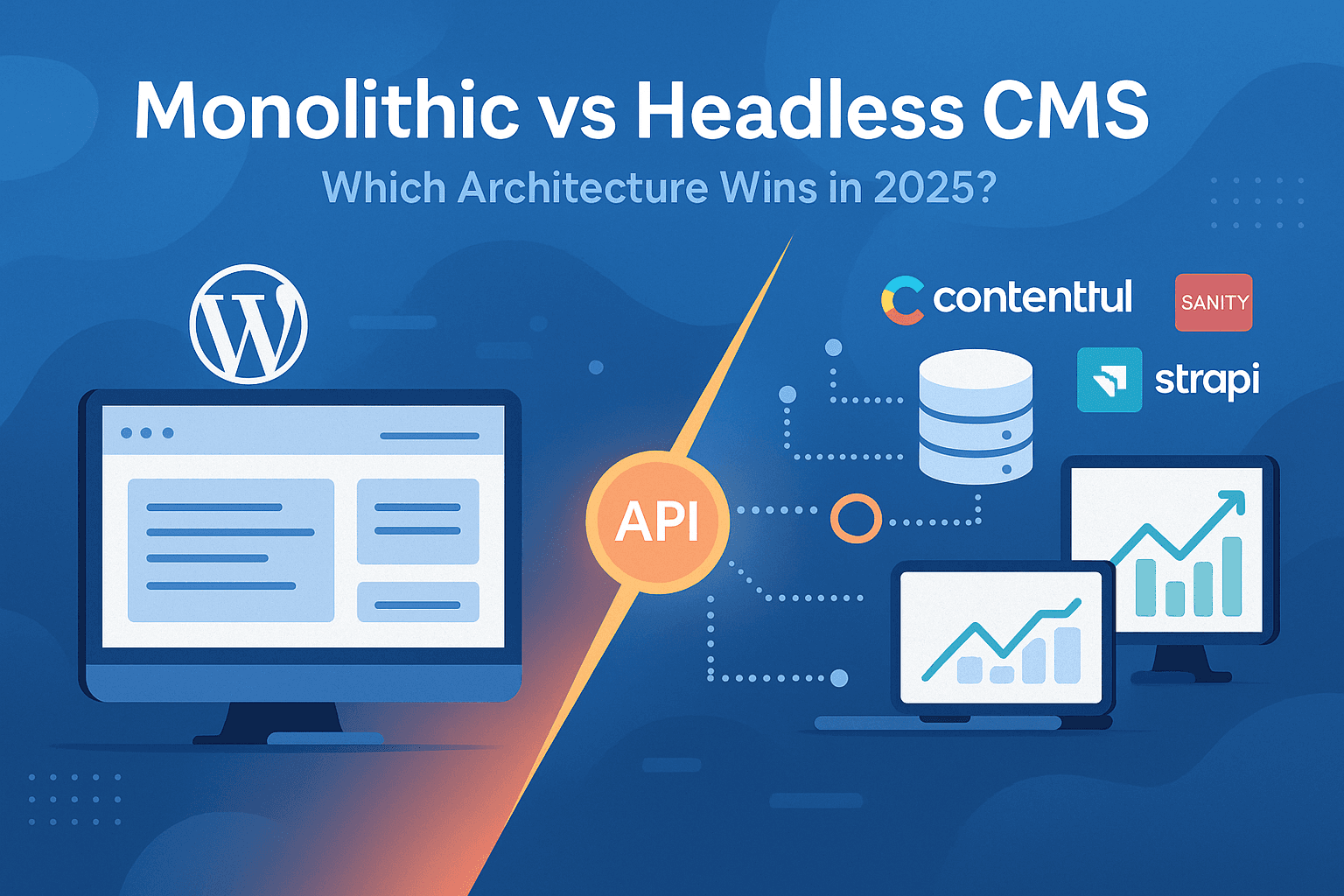
Choosing between Contentful vs Sanity vs Strapi is one of the most consequential decisions you'll make for your next web project. These three headless CMS platforms dominate the market in 2026, and each takes a fundamentally different approach to content management.
Contentful offers enterprise-grade reliability with a premium price tag. Sanity provides developer flexibility with real-time collaboration built in. Strapi gives you complete open-source control at the cost of managing your own infrastructure. The "best" choice depends entirely on your project's complexity, team structure, and budget.
We've built production sites on all three platforms. We run our own site on Sanity, we've deployed client projects on Strapi, and we've worked within Contentful's enterprise constraints. This comparison reflects real development experience, not marketing claims. By the end, you'll know exactly which headless CMS fits your situation.
Quick Comparison: Contentful vs Sanity vs Strapi at a Glance
Before diving deep, here's what you need to know:
| Feature | Contentful | Sanity | Strapi |
|---|---|---|---|
| Best For | Enterprise teams | Creative agencies | Technical startups |
| Starting Price | $300/month | $15/user/month | Free (self-hosted) |
| Hosting | Fully managed | Managed + self-host option | Self-hosted or Cloud ($15/mo+) |
| Query Language | GraphQL | GROQ + GraphQL | REST + GraphQL |
| Real-time Updates | Limited | Excellent | Basic |
| Open Source | No | Partially | Yes |
| Data Ownership | Vendor-controlled | Vendor-controlled | Full control |
Contentful vs Sanity vs Strapi: Getting Started Speed
Let's start with the reality check every developer needs: how painful is the initial setup? Because no matter how powerful a CMS claims to be, if it takes a week to get "Hello World" running, you've got problems.
Contentful: Enterprise Polish, Enterprise Process
Contentful feels like enterprise software from minute one. The onboarding is slick, the documentation is comprehensive, and everything works exactly as advertised. You'll have a basic content model running in 30-60 minutes.
But here's the catch: the free tier is basically a demo. Want webhooks? That's a paid feature. Need more than two locales? Premium only. Custom roles? Enterprise tier. You can prototype quickly, but actually building something production-ready means hitting paywalls fast.
The developer experience is solid though. Their SDKs cover every major language, the API responses are predictable, and error messages actually help you debug.
Sanity: The Creative Developer's Playground
Sanity takes a different approach. Setup takes 45-90 minutes, but that's because you're actually building something custom from the start. Their Studio (the content editing interface) isn't just configurable, it's completely programmable.
You write your content schemas in JavaScript. You customize the editing experience with React components. You can even live-code changes while your content team is working. It's powerful, but it's also a commitment. This isn't a CMS you just install and forget.
The real magic? Real-time collaboration is built into everything. Multiple people can edit the same document simultaneously, Google Docs style. For agencies working with clients who want to be involved in content creation, this is a game-changer.
What's also clever is Sanity's dataset approach. Each project can have multiple datasets (think development, staging, production). Clone them, export them, move between them. You get more control over your data than most managed platforms offer.
Strapi: Own Everything, Configure Everything
Strapi is the Linux of headless CMSs. It's open-source, self-hosted (or now available on Strapi Cloud), and gives you complete control. Setup takes 30-60 minutes if you know Node.js.
What makes Strapi special is that nothing's hidden. Want to modify how authentication works? Edit the code. Need a custom plugin? Build it. Hate how the admin panel looks? Redesign it. You own every line of code, every database table, every API endpoint.
The downside? You also own every problem. No support team to call when things break at 2 AM (unless you're on the enterprise plan). No automatic scaling when traffic spikes. It's powerful, but with great power comes great responsibility.
Contentful vs Sanity vs Strapi: API Power and Developer Control
Setup is one thing, but what about actually building with these platforms? Let's talk about the technical meat: APIs, customization, and developer control.
Contentful API: Enterprise-Grade, Enterprise Restrictions
Contentful's API is what enterprise developers expect. GraphQL and REST endpoints, comprehensive filtering, automatic image transformations, and response times measured in milliseconds. It's rock solid.
Here's how you'd fetch content with Contentful's GraphQL:
query GetArticles {
  articleCollection(limit: 10, order: publishedAt_DESC) {
    items {
      title
      slug
      author {
        name
      }
      publishedAt
    }
  }
}
But flexibility? That's where things get interesting. Content models are defined through the web UI, not code. This is great for non-technical users but frustrating when you want to version control your schema. Want to add a computed field? Not possible. Need conditional validation? Only through apps (which are a paid feature).
Sanity API: GROQ Your World
Sanity took a bold approach: they invented their own query language. GROQ (Graph-Relational Object Queries) sits somewhere between GraphQL and SQL. At first, it seems like unnecessary complexity. Then you write your first projection and realize how powerful it is:
*[_type == "article" && publishedAt < now()] | order(publishedAt desc) [0...10] {
  title,
  slug,
  "author": author->name,
  "readTime": round(length(pt::text(body)) / 1500)
}
That query fetches recent articles, resolves author references, and calculates read time, all server-side. No multiple API calls, no client-side processing.
The real-time API is where Sanity truly shines. Subscribe to changes and get instant updates when content changes. Building a live dashboard or collaborative editor? Sanity makes it almost trivial.
Strapi API: Your API, Your Rules
Strapi gives you what the others can't: complete control. Every API endpoint is customizable. Every controller is editable. Every database query is yours to optimize.
Here's a simple REST fetch with Strapi:
// Fetch articles with Strapi REST API
const response = await fetch('https://your-strapi.com/api/articles?populate=author&sort=publishedAt:desc&pagination[limit]=10');
const { data } = await response.json();
Want GraphQL? It's a plugin you can enable. Need something custom? Write your own endpoints. We've built Strapi projects with custom authentication, complex permission systems, and business logic baked right into the CMS.
The content-type builder deserves special mention. Click together your content model and Strapi generates the entire API, admin UI, and database schema. Make changes, and the API updates automatically.
The Developer Experience That Actually Matters
Beyond features and pricing, there's something harder to quantify but equally important: how does it feel to work with these platforms daily?
Contentful feels corporate. Everything works, but it's not particularly exciting. You're implementing someone else's vision of content management. The constraints can be frustrating for developers who like to tinker, but the predictability is a strength for large teams.
Sanity feels creative. There's genuine joy in crafting custom studio configurations, writing GROQ queries, and watching real-time updates flow. It rewards exploration and experimentation. But it also demands attention. You can't just set it and forget it.
Strapi feels empowering. You own everything, control everything, and can modify everything. For developers who've felt constrained by other CMSs, Strapi is liberating. But freedom has a price: you're responsible for everything too.
This matters more than most comparisons acknowledge. Your team will live inside their CMS daily. Picking a platform that matches your team's working style prevents frustration and reduces churn.
Contentful vs Sanity vs Strapi: 2026 Pricing Compared
Let's talk money, because that's often where decisions get made. Here's what you'll actually pay in 2026:
Contentful Pricing 2026
Contentful doesn't pretend to be cheap. According to Contentful's pricing page:
- Free: 5 users, 2 locales, 1M API calls/month, community support
- Lite: $300/month (small teams, expanded limits)
- Premium: Custom pricing (~$60,000/year base, negotiable down to ~$37,000)
What you're paying for is reliability: 99.95% uptime SLA, global CDN, automatic scaling, 24/7 support. For large brands where downtime means lost revenue, this is worth every penny.
But here's what developers should consider: you're locked in. Your content lives on Contentful's servers, your workflows depend on their features, and switching platforms means a complete migration.
Sanity Pricing 2026
Sanity's pricing model is refreshingly transparent. According to Sanity's pricing page:
- Free: Individuals, basic features, limited resource quotas
- Growth: $15/user/month, 250K API requests, 1M CDN requests, 25K documents
- Enterprise: Custom pricing with SSO, dedicated support
The free tier is actually useful for small projects and prototyping. We run our own website on Sanity's Growth plan, and the pay-as-you-go overage model means you only pay for what you actually use.
Sanity also offers a Startup Program that provides eligible startups one year of free Growth tier access, which makes it especially attractive for new projects.
Strapi Pricing 2026
Strapi recently simplified their pricing by separating CMS features from hosting. According to Strapi's pricing:
- Community (Self-hosted): Free forever, unlimited everything
- Cloud Free: Deploy for $0 (2,500 API requests/month)
- Cloud Essential: $15/month with yearly billing ($18/month monthly), 50K API requests
- Cloud Pro: $75/month (more resources, priority support)
- Enterprise: Custom pricing with review workflows, SSO
The real cost with self-hosted Strapi is your hosting ($20-100/month for VPS) and your time managing infrastructure. Strapi Cloud removes that overhead but adds API request limits.
| Pricing Factor | Contentful | Sanity | Strapi |
|---|---|---|---|
| Entry Price | $300/month | $15/user/month | Free |
| Free Tier Usefulness | Limited (2 locales) | Useful for small projects | Unlimited (self-host) |
| Enterprise Starting | ~$60k/year | Custom | Custom |
| Hosting Included | Yes | Yes | Optional (Cloud) |
| Data Ownership | Vendor-controlled | Vendor-controlled | Full control |
| Migration Difficulty | High | Medium | Low |
Which Headless CMS Should You Choose?
After building dozens of projects across these platforms, we've learned that the "best" CMS depends entirely on your situation.
Choose Contentful When:
- You're an enterprise team managing global content across multiple brands and languages
- You need rock-solid reliability and someone to blame when things break
- Budget isn't your primary concern, uptime and scalability are
- You want comprehensive localization features and global CDN
Contentful excels at structured content at scale. Global retailers, media companies, financial institutions: these are Contentful's sweet spot.
Choose Sanity When:
- You're building something unique that needs custom editorial workflows
- Your content team wants real-time collaboration
- You need flexibility but don't want to manage infrastructure
- You're a digital agency working with clients who want involvement in content creation
Sanity is perfect for creative studios and product teams building content-heavy applications. It's why we chose it for our own web projects.
Choose Strapi When:
- You want complete control and have the technical skills to handle it
- You're building something that needs custom backend logic
- Data sovereignty matters (GDPR, compliance requirements)
- You prefer owning your stack rather than renting it
Strapi is ideal for technically sophisticated teams building custom applications: SaaS products, internal tools, projects with specific compliance requirements.
Contentful vs Sanity vs Strapi: Decision Framework
Start with your constraints:
- Budget limited? Strapi
- Budget flexible? Sanity
- Budget unlimited? Contentful
Then consider your needs:
- Global scale? Contentful wins
- Real-time collaboration? Sanity excels
- Custom backend logic? Strapi only
Finally, think about the future:
- Will you need to migrate? Strapi is easiest to leave
- Will requirements change? Sanity adapts best
- Will you scale massively? Contentful handles it
Key Takeaways: Contentful vs Sanity vs Strapi
- No universal winner exists. The best CMS depends on your team, budget, and project complexity
- Contentful is enterprise-grade with premium pricing ($300-60k+/year). Choose it for global scale and reliability
- Sanity offers the best developer experience with GROQ queries and real-time collaboration ($15/user/month)
- Strapi provides complete open-source control at no licensing cost. You pay only for hosting
- Migration difficulty varies: Strapi is easiest to leave, Contentful has the most lock-in
- Developer experience matters: Pick the platform that matches how your team works, not just which feature list is longest
- All three support modern stacks like Next.js and work well with Jamstack architectures
The Bottom Line
In 2026, the headless CMS landscape isn't about finding the "best" platform. It's about finding the right fit. Contentful brings enterprise stability and global scale. Sanity offers creative flexibility and real-time collaboration. Strapi provides complete control and open-source freedom.
Don't pick a CMS based on hype. Pick it based on your stack, your workflow, and how much control you want. We've seen too many projects fail because teams chose what was popular rather than what was practical.
For most teams, the decision comes down to this: Do you want to own your infrastructure (Strapi), customize your workflows (Sanity), or have everything managed for you (Contentful)? Answer that, and you've got your platform.
Need Help Choosing or Implementing Your Headless CMS?
At Href Creative, we build modern websites with the tech stack that fits your business, whether that's Sanity, Strapi, or a custom Next.js solution. We run our own site on Sanity because it gives us the flexibility we need.
Want expert guidance on your CMS decision? Get in touch for a free consultation.
Related Reading:
- How Much Does a Website Cost in 2026?
- AI Website Builders vs Professional Developers
- Headless Architecture: Pros, Cons, and Who It's Really For
Sources: