The days when CPAs could rely solely on referrals are over.
Yes, word-of-mouth still matters. Satisfied clients still recommend their accountants to friends and colleagues. But something fundamental has changed: even when someone gets a referral, they don't just call anymore. They search.
They look at your website. They check your Google reviews. They compare you to three other CPAs they found online. By the time they reach out, they've already formed an opinion about your practice based on what they found, or didn't find, on the internet.
This shift creates both a challenge and an opportunity. CPAs who ignore digital marketing become invisible to an entire generation of business owners who start every purchasing decision with a search engine. But CPAs who embrace it can attract clients they'd never reach through traditional networking alone.
This guide covers the essential marketing strategies for CPA practices in 2026, from building your brand and optimizing your website to mastering local SEO and creating content that demonstrates your expertise.
Why CPAs Need Marketing Now More Than Ever
The Referral Model Has Changed
Referrals remain valuable, but they work differently now. When a business owner asks a colleague for an accountant recommendation, that recommendation is just the starting point. Research shows that 82% of people investigate professional services online before making contact.
Your potential client receives a referral, types your name into Google, and forms a judgment within seconds. If your website looks outdated, if they can't find reviews, or if your competition appears more professional online, you've lost that referral before you ever knew it existed.
Competition From Non-Traditional Sources
CPAs face increasing competition from bookkeeping services, tax preparation franchises, and software solutions promising to handle what accountants used to do. QuickBooks, FreshBooks, and similar platforms now offer features that small business owners once needed an accountant to provide.
This competition means CPAs must articulate their value clearly. Why should a business owner pay for your expertise when software costs a fraction of your fees? Marketing helps you answer that question before it becomes an objection.
The Advisory Opportunity
Here's the good news: by 2026, Client Advisory Services (CAS) are projected to bring in 30% of CPA firm revenues, up from just 18% in 2020. Advisory services expanded 12% from 2023 to 2024, outpacing growth in traditional tax and audit work.
Clients increasingly want more than compliance. They want strategic guidance on revenue growth, budgeting, KPI tracking, and financial planning. Research shows 65% of buyers prioritize revenue growth modeling, 46% want budgeting help, and 35% seek advanced KPI reporting.
Marketing positions you to capture this advisory demand. The CPA who appears in search results for "fractional CFO for small business" or "tax planning strategies" attracts clients seeking exactly the high-value services that drive practice growth.
Building Your CPA Practice Brand
The Case for Specialization
Trying to serve everyone means connecting with no one. The most successful CPA practices specialize in specific industries or client types: startups, nonprofits, healthcare practices, real estate investors, or manufacturing companies.
Specialization makes your marketing more effective because you can speak directly to specific pain points. A CPA who markets to "small businesses" competes with thousands of generalists. A CPA who markets to "dental practices in Michigan" faces far less competition and can demonstrate deep understanding of their clients' unique challenges.
Consider what industries you already serve well. Where do you have existing expertise or connections? That's likely your niche.
Positioning Beyond Compliance
The compliance work that defined accounting for decades is becoming commoditized. Tax preparation and basic bookkeeping face downward fee pressure as software automates routine tasks.
Your brand should emphasize the strategic value you provide beyond compliance. Position yourself as an advisor who helps clients:
- Make better financial decisions
- Plan for growth and expansion
- Navigate complex transactions
- Optimize their tax position year-round, not just at filing time
- Understand their numbers in ways that drive profitability
This positioning attracts clients willing to pay for expertise rather than those shopping purely on price.
What Clients Actually Want
Understanding buyer preferences helps you position your practice effectively. Research shows 63% of buyers now prefer non-hourly billing, favoring fixed fees or project-based pricing. Additionally, 54% of clients prefer purchasing accounting services in bundled packages.
This suggests clients want predictability and clarity. They'd rather pay a known monthly fee for defined services than worry about how many hours you'll bill. Consider whether your pricing model aligns with what today's clients actually prefer.
For more on marketing professional services effectively, see our complete guide to marketing for professional services firms.
Website Essentials for CPAs
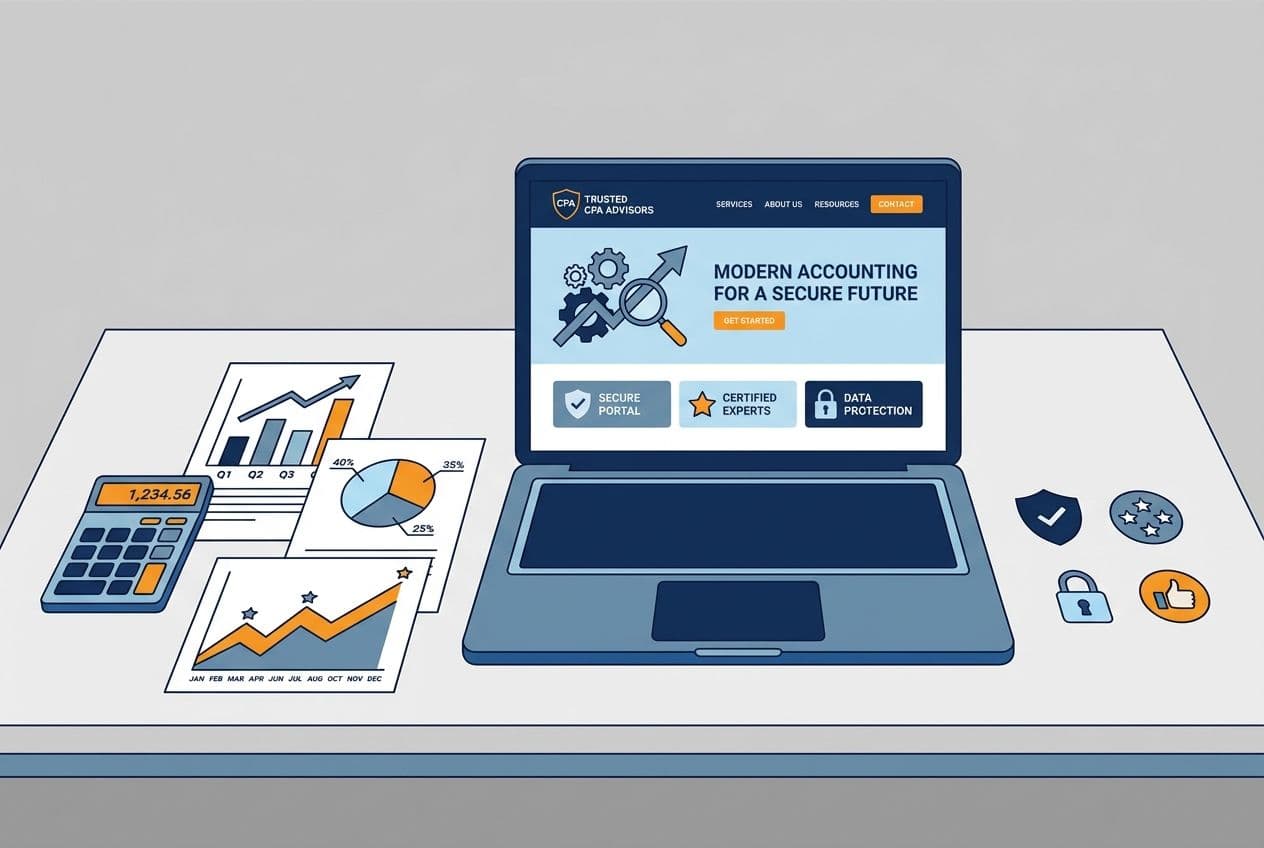
Your website is your 24/7 business development representative. It works while you sleep, answers questions while you're with clients, and makes first impressions you'll never know about if it fails.
Trust Signals That Matter
Professional services live and die on trust. Your website must establish credibility immediately through:
Credentials displayed prominently. Your CPA license, state registrations, and any additional certifications belong above the fold. These provide instant credibility that visitors can verify.
Client testimonials with specifics. Generic praise ("Great accountant!") carries little weight. Specific outcomes ("Reduced our tax liability by $47,000 in the first year") demonstrate actual results.
Professional team photos. Skip the stock images of people in suits shaking hands. Real photos of your actual team build connection and trust.
Security indicators. Display your SSL certificate and any cybersecurity certifications. Clients entrust you with sensitive financial information, and they need to know you protect it.
Association memberships. AICPA membership, state CPA society involvement, and industry association logos signal professional commitment.
Mobile-First Design
At least half of your website visitors are viewing from their phones. If your site doesn't work flawlessly on mobile, if buttons are too small to tap, text too small to read, or pages load slowly, you're losing potential clients.
Mobile optimization isn't optional. It's the baseline expectation.
Clear Calls to Action
Every page should guide visitors toward a next step. Common CTAs for CPA websites include:
- Schedule a consultation
- Download a tax planning guide
- Call for a free assessment
- Request a quote
Make these actions obvious and easy. The harder you make it to contact you, the fewer prospects will bother.
For detailed guidance on building an effective accounting firm website, see our guide to websites for accountants.
SEO for Accounting Firms
Search engine optimization determines whether potential clients find you when they search for accounting services. For local professional services, SEO can be the difference between a full practice and an empty calendar.
Local SEO Fundamentals
Most CPA practices serve a defined geographic area. Even if you work with clients remotely, many prospects search with local intent: "CPA near me," "accountant in [city]," or "tax preparer [neighborhood]."
Google Business Profile is essential. This free listing often appears before organic search results. Claim your profile, add accurate business information, upload photos of your office and team, and post updates regularly. The firms that dominate local search all have optimized Google Business Profiles.
Reviews drive rankings. Google considers review quantity and quality when determining local rankings. Actively encourage satisfied clients to leave reviews. Make it easy by sending them a direct link.
Consistent NAP everywhere. Your Name, Address, and Phone number should be identical across your website, Google Business Profile, and every directory listing. Inconsistencies confuse search engines.
Keyword Strategy for CPAs
Focus on keywords that indicate buying intent. Someone searching "what does a CPA do" is just curious. Someone searching "CPA for small business [city]" is looking to hire.
High-value keyword patterns for CPAs include:
- "[Service] + [location]" (tax planning Detroit)
- "[Industry] + accountant" (restaurant accountant)
- "CPA for [client type]" (CPA for freelancers)
- "[Specialty] + near me" (bookkeeping services near me)
Build dedicated pages for each major service and each geographic area you serve. A page optimized for "small business accountant Ann Arbor" has a much better chance of ranking than your homepage trying to rank for everything.
Realistic Timeline
Local SEO typically takes 90-120 days to show significant results. Firms that commit to the process can expect to appear in the top 3 Google results for local terms within that timeframe, generating 50-100+ qualified leads per year from search alone.
The firms that fail are those who quit after three months, right before results would have appeared.
Content That Builds Trust
Content marketing for CPAs isn't about generating traffic for its own sake. It's about demonstrating the expertise that justifies your fees. Every piece of content should answer: "Does this show prospects we know what we're doing?"
What to Write About
The most effective content addresses questions your ideal clients actually have:
Regulatory and tax updates. When tax laws change, business owners need to understand the implications. Position yourself as the reliable source for what changes mean for their specific situation.
Industry-specific guidance. If you specialize in restaurants, write about restaurant-specific tax strategies. If you serve contractors, address construction industry accounting challenges. Niche content attracts niche clients.
Practical how-to content. Checklists, guides, and step-by-step instructions demonstrate expertise while providing genuine value. A "Year-End Tax Planning Checklist for Small Businesses" serves prospects while showcasing your knowledge.
Common mistakes and how to avoid them. Content like "5 Tax Deductions Most Small Businesses Miss" addresses real pain points while positioning you as someone who catches what others overlook.
Frequency and Consistency
You don't need to publish daily. Quality matters more than quantity. One substantial, genuinely helpful article per month builds more credibility than weekly thin posts that say nothing distinctive.
Research shows 71% of B2B buyers consume 3-5 pieces of content before engaging with a firm. Your content library doesn't need to be vast, but it needs to demonstrate real expertise.
Content That Converts
Not all content serves the same purpose. Some content attracts search traffic (guides, how-to articles). Other content converts visitors into leads (case studies, comparison pages, consultation offers).
A healthy content strategy includes both. Traffic content fills your funnel. Conversion content turns that traffic into consultations.
Client Acquisition Strategies
Email Marketing
Email remains one of the most effective marketing channels, with an average return of $36 for every $1 spent. For CPAs, email serves multiple purposes:
Nurture prospects over time. Professional services have long sales cycles. Someone who downloads your tax guide today might not need an accountant for months. Regular emails keep you top-of-mind until they're ready.
Stay connected with existing clients. Periodic updates about regulatory changes, deadline reminders, and check-ins maintain relationships between engagements.
Generate referrals. Clients who are happy to refer often just need to be asked. Email makes asking easy and scalable.
Build your list by offering valuable resources in exchange for email addresses: tax planning guides, year-end checklists, industry-specific resources.
Paid Advertising
Pay-per-click advertising puts you in front of people actively searching for CPA services. For accounting firms, Google Ads targeting high-intent keywords ("hire a CPA," "small business accountant [city]") can generate immediate visibility.
Expect professional services keywords to cost $20-50+ per click. A meaningful test requires at least $1,000-2,000 per month over several months. Track cost per lead carefully to ensure positive returns.
Referral Programs
Word-of-mouth remains powerful, but you can make it more systematic. Consider:
- Simply asking satisfied clients for referrals
- Offering a small thank-you for successful referrals
- Making it easy with shareable content or direct introduction requests
- Following up with referral sources to let them know the outcome
The best clients often come from existing client referrals. A formalized referral program ensures you're not leaving this source to chance.
Marketing Automation
For many firms, growth starts with automation. Streamlining client intake, scheduling, email follow-ups, and nurture campaigns saves time while ensuring consistency.
Firms that clearly communicate the benefits of automation to clients are 3.5x more likely to raise their prices successfully. Efficiency gains translate to better service and healthier margins.
How Much Should You Spend on Marketing?
Industry benchmarks suggest accounting firms should allocate 3-10% of revenue to marketing. High-growth firms consistently spend more than twice what average-growth firms spend.
Start where you are. If you've never invested in marketing, beginning with 3% of revenue and measuring results gives you data to inform future decisions. As you see what works, you can increase investment in channels that produce returns.
The question isn't whether you can afford marketing. It's whether you can afford to remain invisible while competitors build their online presence.
Conclusion
Marketing your CPA practice comes down to one fundamental principle: you must build trust before you can build a client relationship. Every strategy in this guide, from your website to your content to your local SEO presence, serves that central purpose.
Start with your foundation. Create a website that establishes credibility instantly and makes it easy for prospects to take the next step.
Invest in local SEO. For most CPA practices, appearing in local search results is the highest-return marketing investment you can make.
Create content consistently. One quality piece per month compounds over time into a library that demonstrates expertise and attracts clients around the clock.
Professional services marketing requires patience. Results build gradually as content ranks, reputation grows, and relationships develop. The practices that succeed commit to consistent effort over months and years.
Your expertise deserves to be visible. The strategies in this guide will help the clients who need you actually find you.